

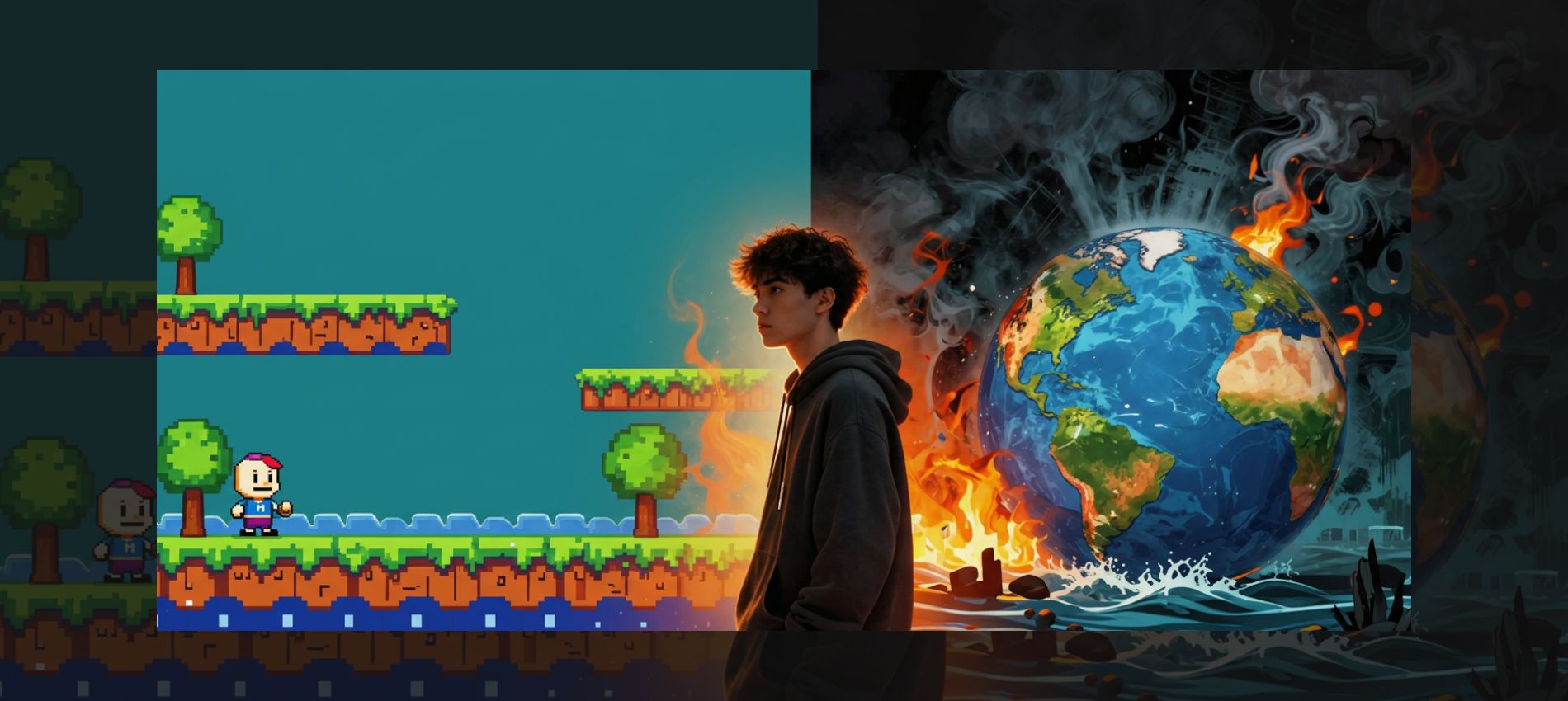
From Poptropica to Climate Anxiety: Is It Silly to Think Gen Z Can Still Save the World?
June 2, 2026
Picture this: You log on, and you’re instantly dropped into a barren, burning wasteland. You have no idea how you got there, but a sad, gray-haired version of yourself is standing nearby, looking completely defeated. They deliver some pretty heavy news—humans have officially ruined the planet, and your only hope of fixing this bleak future is to travel back in time to patch up history.
If you were a kid online in the late aughts, this isn’t a new eco-dystopian thriller—it’s just a core memory of playing Poptropica’s Time Tangled Island.
It turns out that this quirky, pixelated childhood game, created by Diary of a Wimpy Kid author Jeff Kinney, was actually the ultimate blueprint for the gen z experience. We were told we had the power to save the world before we were even old enough to have a middle school crush. But now that we’re staring down the realities of 2026, a lot of us are wondering: Is it silly to think we actually still can?
Welcome to the Ultimate Dystopian Simulation
Launched back in 2007—the exact same year the world met the very first iPhone and stumbled into the Great Recession—Poptropica was a digital sanctuary for millions of kids. On the surface, it was an educational point-and-click game where your big-headed, stick-limbed avatar solved historical puzzles. But looking back, the subtext was wild.
A recent viral Reddit thread in the $r/Poptropica$ community perfectly captured the existential crisis hitting older gen z players today. One user confessed to replaying Time Tangled Island as a “miserable, 26-year-old divorcee,” realizing the profound irony of their childhood optimism:
“I felt so optimistic about the future and how cool it would be to experience such a future in real life… [Climate] change isn’t being fixed, our technological advancement of AIs has created fake cat videos rather than robot servants, and I’m already looking more like my future Poptropica avatar than my present one.”
Here’s a mind-bending easter egg: when the island dropped in 2008, the “dystopian future” you had to fix was set in 2058. Every year after, the developers updated the code so the future was always exactly 50 years away. But as gen z knows all too well, real-world timelines don’t bend to childhood game code. We didn’t get a 50-year head start. The future we were supposed to prevent is happening right now.
The Weight of Growing Up “Unprecedented”
Let’s be real—gen z has spent their entire lives living through historic events that nobody asked for. Born in the shadow of 9/11 and entering adulthood in the middle of a global pandemic, our generation’s ethos is defined by a bizarre mix of terrible timing and collective burnout.
We’ve grown up using the word “unprecedented” so often that it’s honestly kind of embarrassing. When everything is a once-in-a-generation crisis, nothing is.
Remember eighth-grade biology class? For many of us, that was the moment the crushing weight of climate anxiety set in. You take a carbon footprint quiz, realize your lifestyle is contributing to global warming, and suddenly you’re a 13-year-old carrying the guilt of the planet’s imminent doom.
Yet, the adults in charge seemed totally checked out. During the 2016 presidential debates, climate change didn’t even get a single question. Instead, the world watched a performance of political outrage while the planet kept simmering. We vent on our private stories and spam our close friends’ feeds with existential dread, only to wake up the next morning, go to school, or head to our corporate cubicles like everything is totally fine.
The Lonely Irony of Modern Activism
The hardest pill for gen z to swallow is the sheer isolation of the digital age. We’re taught that saving the planet is an individual responsibility, which leads to some pretty hilarious (and painful) everyday contradictions:
- We order aesthetic, reusable water bottles using overnight shipping from Amazon.
- We dutifully sort our recycling while knowing deep down it’s largely a corporate myth.
- We pay licensed therapists to help us manage climate anxiety caused by problems we didn’t create and can’t fix alone.
It feels like we’re all playing our own separate, solitary games of Poptropica, staring at our screens and wondering if anyone else sees the smoke rising outside the window. But blaming ourselves or each other just feeds into the isolation that got us here in the first place.
According to a 2024 study published in The Lancet Planetary Health, more than half of gen z adults seriously consider the environmental impacts of even having children. The biological urge to build a future is actively clashing with the harsh atmosphere of the world we actually inherited. It’s heavy, and it’s deeply unfair.
Glitch Goth and Reclaiming Real Connection in 2026
But if there’s one thing about gen z, we are going to find a way to make it a vibe. Enter Glitch Goth—the definitive post-AI anti-aesthetic of 2026.
As algorithms become more sterile and AI threatens to fake everything from pop tracks to cat videos, gen z is leaning heavily into the glitch. We are intentionally injecting human friction back into our lives.
Instead of hiding behind screens, we are reclaiming the physical world in the coolest ways possible:
- Flip phones are officially back as the ultimate digital detox statement.
- Book clubs and local analog hobbies have replaced endless doomscrolling.
- We’re waking up at dawn for group run clubs and aggressively rating local spots on Beli just to feel a sense of community.
We are going out of our way to find each other in a chaotic digital landscape because we’ve realized that collective connection is the only real antidote to the matrix.
So, Are We Still Saving the World?
At the end of Time Tangled Island, after jumping through two millennia of history and wearing your digital feet to the bone, you finally fix the timeline. The sky turns a beautiful, vibrant teal. You’re rewarded with a shiny golden medallion, and you get to relax in a futuristic sky home.
But you don’t stay there long. Eventually, your avatar gets restless, climbs back into the hot-air balloon, and ascends further into the sky to see what else is out there.
Gen z might have been dropped into a simulation we didn’t design, holding a time-travel device we didn’t ask for. The future looks messy, and the records for heatwaves and natural disasters are being broken constantly. But as we step into our full autonomy as adults, we are realizing we don’t have to accept the world exactly as it was handed to us.
Is it silly to think we can still save the world? Maybe a little. But looking at how this generation continues to choose connection over despair, it’s a safe bet that the future we make is going to be worth the ride.
Follow D-Muse to stay current with fashion trends, lifestyle tips, and exciting events. DM us @dmusemagz now to get all the information you need!