


Leonardo DiCaprio Raises Concern Over Indonesia’s Forest Fires and Orangutan Habitat
October 8, 2026
Hollywood actor and environmental activist Leonardo DiCaprio is once again using his platform to draw attention to an environmental crisis. This time, his focus is on the forest and land fires, or karhutla, affecting parts of Indonesia, particularly the islands of Kalimantan and Sumatra.
On October 4, 2026, Leonardo DiCaprio shared a post on Instagram highlighting the scale of the fires and their consequences for forests, wildlife, and local communities. His post pointed to more than 2 million acres of forest burned across the two islands, equivalent to roughly 800,000 hectares.
But the numbers are only part of the story. Behind the enormous area of burned forest are ecosystems, communities, and wildlife struggling to survive. Among those facing serious consequences are Bornean orangutans, whose habitats are increasingly threatened by fires and the destruction of forests.
Leonardo DiCaprio Highlights the Impact of the Fires
In his Instagram post, Leonardo DiCaprio highlighted the extensive damage caused by the fires in Kalimantan and Sumatra.
Forest fires are not simply about trees being burned. When large areas of forest disappear, the animals that depend on those ecosystems can lose their homes, food sources, and routes for moving through the forest.
The situation is particularly concerning for Bornean orangutans. These animals rely heavily on forest ecosystems, meaning that the destruction of their habitat can directly affect their ability to survive.
DiCaprio also drew attention to the impact of smoke on communities. When forest and land fires continue to burn, smoke and haze can spread far beyond the immediate fire zone, affecting the people living in surrounding areas.
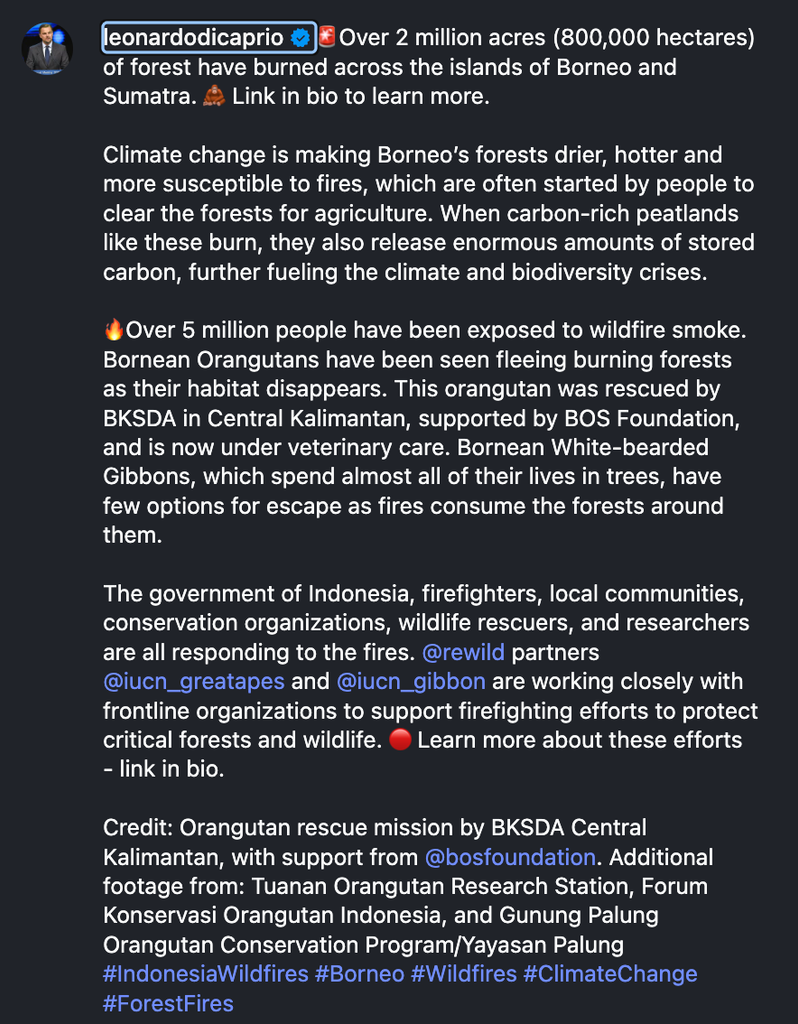
So, the issue is much bigger than what can be seen from a satellite image of a burning forest. It is also a human and wildlife crisis.
Orangutans Are Among the Animals Being Rescued
The situation on the ground gives an even clearer picture of how karhutla is affecting wildlife.
According to the Ministry of Forestry’s records, 24 wild animals were rescued from areas affected by forest and land fires in West Kalimantan between August 1 and September 10, 2026.
Of those 24 animals, 15 were orangutans.
That number is particularly concerning because orangutans are already strongly dependent on forest habitats. When their environment is damaged or destroyed, they may be forced to move into unfamiliar areas in search of food and safety.
Rescue efforts therefore become an important part of responding to the fires. Wildlife teams have to locate animals that may be trapped, weakened, displaced, or exposed to smoke.
One Orangutan Was Found in Weak Condition
One of the rescued orangutans reportedly showed just how serious the situation can become.
The animal was found in a weak condition near a fire-affected area in Ketapang, West Kalimantan. After being exposed to smoke, it required medical treatment.
For many people watching the fires from afar, smoke can feel like an environmental inconvenience. But for animals living directly inside or near burning forests, smoke can become a serious threat.
An orangutan cannot simply leave the area and find another safe home whenever a fire starts. Its survival depends on access to a suitable forest ecosystem.
When that ecosystem is burning, the animal can be left with very few options.
Why Orangutan Habitat Matters
Bornean orangutans are closely connected to the forests of Kalimantan. Their habitat provides the food, shelter, and environment they need to survive.
The destruction of those forests can therefore have consequences that continue long after a fire has been extinguished.
Even when the flames disappear, a burned ecosystem does not immediately return to normal. Vegetation needs time to recover, while animals may have already been displaced.
For species that depend on large and connected forest habitats, repeated fires can make survival even more difficult.
This is why the environmental concerns highlighted by Leonardo DiCaprio extend beyond the immediate images of flames and smoke.
The bigger question is what happens to these ecosystems afterward.
Leonardo DiCaprio Has Long Focused on Conservation
This is not the first time Leonardo DiCaprio has spoken publicly about environmental issues.
The actor has spent years using his public platform to raise awareness about climate change, environmental protection, and wildlife conservation.
His environmental advocacy has frequently focused on the relationship between human activity, climate change, and the survival of vulnerable ecosystems.
His latest post about Indonesia’s fires fits into that broader pattern.
By sharing information with his international audience, DiCaprio is helping bring attention to an issue that might otherwise receive less visibility outside the region.
For Indonesia, international attention can also highlight the importance of protecting forests and wildlife while efforts to manage fires continue.
The Fire Crisis Affects More Than Forests
One important takeaway from the situation is that forest and land fires should not be viewed as an isolated environmental problem.
They affect several interconnected areas at once.
There is the immediate destruction of vegetation. There is the loss of animal habitat. There is smoke exposure for wildlife. And there are communities that have to deal with deteriorating air quality.
When these impacts happen simultaneously, the consequences can become much more serious.
The orangutans rescued in West Kalimantan are a visible reminder of this connection. Their condition shows what happens when wildlife becomes caught in an environmental crisis that it cannot control.
What Can Be Done?
Responding to forest fires requires more than putting out individual fires.
Fire prevention, forest protection, wildlife rescue, habitat restoration, and community protection all play important roles.
For wildlife, rescue teams can provide immediate assistance to animals found in dangerous conditions. But long-term conservation also requires protecting the forests where these animals naturally live.
That means preventing repeated habitat destruction and ensuring that damaged ecosystems have opportunities to recover.
The attention from Leonardo DiCaprio may help more people understand this bigger picture.
Final Thoughts
Leonardo DiCaprio’s post has once again placed Indonesia’s environmental challenges in the international spotlight.
The forest and land fires in Kalimantan and Sumatra have affected vast areas, while wildlife—including Bornean orangutans—faces the direct consequences of habitat destruction and smoke exposure.
The rescue of 24 wild animals, including 15 orangutans, in West Kalimantan shows that the impact is already being felt on the ground. One rescued orangutan even required medical treatment after being found weak near a fire-affected area in Ketapang.
For Leonardo DiCaprio, highlighting the fires is part of his broader commitment to environmental and wildlife issues. For everyone else, it is a reminder that forest fires are not just about burning land. They are about people, ecosystems, and animals whose survival depends on those forests.
And perhaps the biggest question is not only how we respond when the fires happen, but how we can prevent these forests—and the lives connected to them—from being lost in the first place.
Follow D-Muse to stay current with fashion trends, lifestyle tips, and exciting events. DM us @dmusemagz now to get all the information you need!